Dernière mise à jour le 14/07/2026
politique de confidentialité
I – Quel est l’objet de la présente Politique de confidentialité ?
MODJO s’inscrit dans une démarche continue de mise en conformité avec le Règlement (UE) 2016/679 du Parlement européen et du Conseil du 27 avril 2016 relatif à la protection des personnes physiques à l’égard du traitement des données à caractère personnel et à la libre circulation de ces données, et abrogeant la Directive 95/46/CE (le règlement général sur la protection des données – « RGPD »), la Loi n° 78-17 du 6 janvier 1978 relative à l’informatique, aux fichiers et aux libertés (ci-après la « LIL »), telle que modifiée, notamment par la Loi n° 2018-493 du 20 juin 2018, le Règlement (UE) 2018/1725, ainsi que l’ensemble des exigences légales et réglementaires applicables à MODJO, notamment en matière de sécurité informatique (collectivement, la « Réglementation Applicable »), afin que toutes les Données à caractère personnel soient traitées de manière transparente, confidentielle et sécurisée.
Afin de traduire cet engagement, la présente Politique de confidentialité a pour objet d’exposer comment et pourquoi vos Données à caractère personnel sont traitées par MODJO, de vous rappeler vos droits et les modalités de leur exercice, et de décrire les engagements et mesures pratiques mis en œuvre par MODJO afin de protéger les Données à caractère personnel des visiteurs, utilisateurs, clients, prospects, candidats et partenaires (ci-après les « Personnes concernées »),
- dans le cadre du test, de l’utilisation, de la promotion ou distribution effectué(e)s par eux de la Plateforme (ci-après définie) d’intelligence artificielle MODJO et des produits et services y associés (ci-après les « Services »), et
- lorsqu’ils accèdent à notre site Internet https://www.modjo.ai/ et le consultent (ci-après le « Site Internet »), et
- lorsqu’ils interagissent avec nos réseaux sociaux (ci-après nos « Réseaux sociaux »), et
- lorsqu’ils échangent ou négocient avec MODJO et, plus généralement, entretiennent des relations commerciales avec MODJO,
- ainsi que lorsque des utilisateurs autorisés du Client (ci-après défini) activent, configurent ou utilisent des Connecteurs ou des Services Tiers en lien avec les Services ou les Interfaces.
S’agissant des Traitements de Données à caractère personnel pour lesquels MODJO agit en qualité de Sous-traitant, notamment les Traitements relatifs à vos clients ou prospects que vous pouvez nous confier dans le cadre de l’utilisation de nos Services, il vous appartient de veiller au respect des droits des Personnes concernées et, plus généralement, de la Réglementation Applicable.
Lorsque vos Données à caractère personnel sont traitées par un Client de MODJO, veuillez vous reporter à la politique de confidentialité dudit Client ou aux informations qu’il vous a fournies au sujet de ses activités de Traitement.
Lorsque des Données à caractère personnel sont traitées par l’intermédiaire d’un Connecteur ou d’un Service Tiers, veuillez vous reporter à la politique de confidentialité dudit Connecteur ou dudit Service Tiers, ou aux informations qu’il a fournies au sujet de ses activités de Traitement.
La présente Politique de confidentialité peut être mise à jour périodiquement, notamment afin de tenir compte de l’évolution de nos services, de nos technologies ou de la Réglementation Applicable. Ces mises à jour prendront effet dès leur mise à disposition sur notre Site Internet ou via la Plateforme.
Les Conditions Générales de Vente de MODJO (ci-après les « CGV ») sont accessibles en suivant ce lien ; elles comprennent les stipulations relatives à la protection des Données à caractère personnel, régies par l’Accord de Traitement de Données (ci-après le « DPA »), accessible en suivant ce lien.
Pour toute question concernant la présente Politique de confidentialité ou, plus généralement, la collecte et le Traitement de vos Données à caractère personnel par MODJO, vous pouvez nous contacter à l’adresse électronique suivante : dpo@modjo.ai.
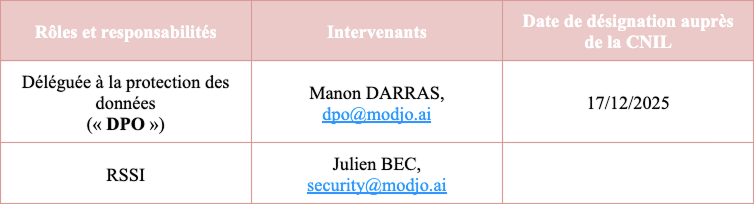
II – Qui pouvez-vous contacter au sein de l’organisation interne de MODJO ?
III – Que sont les « Données à caractère personnel » ?
3.1 Le RGPD et la LIL prévoient les définitions suivantes :
3.1.1 « Données à caractère personnel » (article 4, point 1, du RGPD)
Les Données à caractère personnel désignent toute information se rapportant à une personne physique identifiée ou identifiable (ci-après une « Personne concernée »).
Est réputée être une personne physique identifiable une personne physique qui peut être identifiée, directement ou indirectement, notamment par référence à un identifiant tel qu’un nom, un numéro d’identification, des données de localisation, un identifiant en ligne, ou à un ou plusieurs éléments spécifiques propres à son identité physique, physiologique, génétique, psychique, économique, culturelle ou sociale.
Dès lors que ces données concernent des personnes physiques, celles-ci doivent en conserver la maîtrise.
Une personne physique peut être identifiée :
- directement (par exemple : nom et prénom) ;
- indirectement (par exemple : au moyen d’un numéro de téléphone, d’un numéro d’immatriculation de véhicule, du numéro de sécurité sociale, d’une adresse postale ou électronique, ainsi que par la voix ou l’image).
L’identification peut être réalisée au moyen :
- d’une seule donnée (par exemple : votre nom) ;
- d’un recoupement, par la mise en relation d’un ensemble de données (par exemple : un homme vêtu d’un costume rose, prenant son café exactement à la même heure, à la même adresse de café, chaque mardi).
3.1.2 « Traitement » (article 4, point 2, du RGPD)
Toute opération ou tout ensemble d’opérations effectué ou non à l’aide de procédés automatisés et appliqué à des Données à caractère personnel ou à des ensembles de Données à caractère personnel, telles que la collecte, l’enregistrement, l’organisation, la structuration, la conservation, l’adaptation ou la modification, l’extraction, la consultation, l’utilisation, la communication par transmission, la diffusion ou toute autre forme de mise à disposition, le rapprochement ou l’interconnexion, la limitation, l’effacement ou la destruction.
En conséquence, le Traitement de Données à caractère personnel désigne toute opération ou tout ensemble d’opérations portant sur des Données à caractère personnel, quel que soit le procédé utilisé (collecte, enregistrement, organisation, conservation, adaptation, modification, extraction, consultation, utilisation, communication par transmission ou diffusion ou toute autre forme de mise à disposition, rapprochement).
Le Traitement de Données à caractère personnel n’est pas nécessairement informatisé : les fichiers papier sont également concernés et doivent être protégés dans les mêmes conditions.
Toute opération de Traitement doit poursuivre une finalité déterminée avant la collecte et l’utilisation des données.
3.1.3 « Responsable du traitement » (article 4, point 7, du RGPD)
La personne physique ou morale, l’autorité publique, le service ou tout autre organisme qui, seul ou conjointement avec d’autres, détermine les finalités et les moyens du Traitement ; lorsque les finalités et les moyens de ce Traitement sont déterminés par le droit de l’Union ou le droit d’un État membre, le Responsable du traitement peut être désigné ou les critères spécifiques applicables à sa désignation peuvent être prévus par le droit de l’Union ou par le droit d’un État membre.
3.1.4 « Sous-traitant » (article 4, point 8, du RGPD)
La personne physique ou morale, l’autorité publique, le service ou tout autre organisme qui traite des Données à caractère personnel pour le compte du Responsable du traitement.
3.1.5 « Violation de Données à caractère personnel » (article 4, point 12, du RGPD)
Une Violation de Données à caractère personnel désigne une violation de la sécurité entraînant, de manière accidentelle ou illicite, la destruction, la perte, l’altération, la divulgation non autorisée de Données à caractère personnel transmises, conservées ou traitées d’une autre manière, ou l’accès non autorisé à de telles données.
3.1.6 « Données Sensibles » (article 9, paragraphe 1, du RGPD)
Les Données Sensibles constituent une catégorie particulière de Données à caractère personnel.
Il s’agit des informations révélant l’origine raciale ou ethnique, les opinions politiques, les convictions religieuses ou philosophiques ou l’appartenance syndicale, ainsi que du Traitement des données génétiques, des données biométriques aux fins d’identifier une personne physique de manière unique, des données concernant la santé ou des données concernant la vie sexuelle ou l’orientation sexuelle d’une personne physique.
Le Règlement interdit la collecte ou l’utilisation de telles données, sauf notamment dans les cas suivants (article 9 du RGPD) :
- lorsque la Personne concernée a donné son consentement explicite (manifestation active, explicite et, de préférence, écrite, qui doit être libre, spécifique et éclairée) ;
- lorsque les informations ont été manifestement rendues publiques par la Personne concernée ;
- lorsque les informations sont nécessaires à la sauvegarde de la vie humaine ;
- lorsque leur utilisation est justifiée par l’intérêt public et autorisée par la CNIL ;
- lorsque les informations concernent les membres ou adhérents d’une association ou organisation à caractère politique, religieux, philosophique ou syndical.
3.2 Définitions complémentaires aux fins de la présente Politique de confidentialité :
3.2.1 « Client » : désigne les clients de MODJO qui utilisent les Services de MODJO et qui ont, à ce titre, accepté les CGV, le DPA et la Politique de confidentialité de MODJO.
3.2.2 « Services » : désigne la Plateforme de MODJO et les produits et services y associés. Les Services sont régis par les CGV et le DPA.
3.2.3 « Plateforme » : désigne la plateforme de MODJO, accessible après être devenu Client de MODJO ou partenaire officiel.
3.2.4 « Interface(s) » : désigne les API, protocoles MCP, webhooks, points de terminaison, mécanismes d’authentification, interfaces compatibles MCP, extension Chrome, comptes de service et autres interfaces programmatiques de MODJO, mis à disposition par MODJO afin de permettre aux utilisateurs autorisés des Clients d’accéder aux informations issues de la Plateforme ou d’interagir avec celles-ci.
Les Interfaces constituent des canaux d’accès techniques faisant partie des Services. Elles ne constituent pas, en tant que telles, des Services Tiers, bien qu’elles puissent être utilisées par des Connecteurs et des Services Tiers sélectionnés, configurés, activés ou autorisés par le Client, ou conjointement avec ceux-ci.
3.2.5 « Connecteur(s) » : désigne tout connecteur, application, système, plateforme, environnement, module d’extension, intégration, action, agent, MCP client ou autre connecteur technique tiers permettant aux utilisateurs autorisés du Client d’accéder à la Plateforme ou aux Interfaces, de les interroger ou d’interagir avec elles depuis, ou par l’intermédiaire d’un environnement externe, notamment des plateformes, modèles ou environnements d’assistant ou d’agent d’intelligence artificielle exploités par un tiers, tels que, sans que cette liste soit limitative, Anthropic, OpenAI, Dust ou des environnements similaires.
Selon les fonctionnalités du Connecteur, le Client peut généralement gérer, directement depuis le Connecteur, les éléments de la Plateforme mis à la disposition de celui-ci, en choisissant d’en autoriser ou d’en bloquer l’accès.
Les Connecteurs peuvent techniquement initier, acheminer ou relayer des instructions, prompts, requêtes, demandes, données d’entrée ou données de sortie entre le Client, ses utilisateurs autorisés, le Service Tiers concerné et la Plateforme.
Les Connecteurs sont des Services Tiers.
3.2.6 « Services Tiers » : désigne les services tiers ou côté Client, y compris les Connecteurs, connectés à la Plateforme ou aux Interfaces, synchronisés avec celles-ci, leur envoyant des données, en recevant ou interopérant avec elles de toute autre manière, notamment les systèmes CRM, services de messagerie électronique, services de calendrier, outils de réunion et de visioconférence, services de VoIP, suites bureautiques, solutions de stockage, outils d’engagement commercial, robots iPaaS ou outils d’intergiciel, entrepôts de données, outils de communication et applications professionnelles similaires, ainsi que les services par l’intermédiaire desquels les Connecteurs ou les Interfaces sont utilisés et connectés.
Restriction : les Connecteurs et les Services Tiers ne doivent pas être utilisés pour contourner, affaiblir ou neutraliser les mécanismes de protection techniques, contractuels, de confidentialité, de sécurité ou relatifs à l’IA mis en œuvre au sein des Services, notamment les contrôles d’accès, autorisations fondées sur les rôles, circuits d’approbation, exigences d’authentification, limitations de débit, restrictions d’utilisation, journaux d’audit, contrôles de minimisation des données, obligations de confidentialité, filtres de sécurité ou toute autre mesure destinée à protéger les Données à caractère personnel et les Services.
En particulier, le Client doit veiller à ce que les Connecteurs et les Services Tiers ne soient pas utilisés à des fins d’accès non autorisé, d’élévation de privilèges, de contournement des limites contractuelles d’utilisation, d’injection de prompt, de divulgation de secrets ou d’identifiants, de divulgation non autorisée d’informations confidentielles ou de Traitement de Données Sensibles.
Conditions d’utilisation : le Client doit s’assurer que (a) les clés API, jetons, identifiants, comptes de service et mécanismes d’authentification sont générés, conservés, renouvelés, restreints et révoqués conformément aux normes de sécurité appropriées et que (b), plus généralement, les Connecteurs et les Services Tiers sont (i) sécurisés, (ii) conformes à la Réglementation Applicable et (iii) conformes aux CGV.
Lorsqu’il utilise des Services Tiers, le Client doit également respecter les conditions générales de ces Services Tiers, notamment celles relatives à la protection des données.
Exclusion de responsabilité : le Client demeure responsable des actes et omissions de ses utilisateurs autorisés ainsi que de toutes instructions, prompts, requêtes, appels API, configurations de webhooks, agents, automatisations, données d’entrée, données de sortie, extractions en masse, opérations de scraping, reconstitutions de jeux de données, exfiltrations de données, exportations ou divulgations ultérieures initiées par l’intermédiaire de Connecteurs et de Services Tiers, notamment en lien avec les Interfaces. MODJO ne saurait encourir aucune responsabilité, de quelque nature que ce soit, au titre de l’utilisation, par le Client, de Connecteurs et de Services Tiers, notamment s’agissant des pratiques de ces Connecteurs et Services Tiers en matière de protection des données, de sécurité, de confidentialité, de conservation, d’entraînement de modèles, de transferts internationaux ou de Traitement de données, sauf dans la mesure où une telle responsabilité ne peut être exclue en vertu du droit applicable.
3.2.7 « Données d’intégration » : désigne les Données à caractère personnel traitées dans le cadre de l’utilisation de Services Tiers, y compris avec les Interfaces, notamment les données d’authentification et d’autorisation, identifiants de compte et d’espace de travail, périmètres d’autorisation, appels API, demandes adressées aux outils, prompts ou instructions, données d’entrée et de sortie, charges utiles des webhooks, données extraites de la Plateforme ou transmises à celle-ci, choix de configuration, ainsi que les journaux techniques, de sécurité, de diagnostic et d’audit nécessaires pour fournir, sécuriser, documenter et dépanner l’accès ou l’interaction concerné.
IV – Quelles Données à caractère personnel sont collectées ?
MODJO peut collecter des Données à caractère personnel concernant les Clients et prospects des Services lorsque vous testez ou utilisez les Services, lorsque vous consultez nos Sites Internet et nos Réseaux sociaux, dans le cadre de la promotion, de la distribution et de toute autre négociation relative à nos produits et services, ainsi que des Données à caractère personnel relatives à des partenaires, fournisseurs, intégrateurs, etc. MODJO peut également collecter des Données à caractère personnel concernant des candidats dans le cadre de ses activités de recrutement.
Lorsque nous traitons des Données à caractère personnel pour le compte de nos Clients et sur leurs instructions, nous le faisons conformément aux conditions prévues par notre Accord de Traitement de Données. En conséquence, la présente Politique de confidentialité, qui décrit les pratiques de Traitement de MODJO, ne régit pas les pratiques de Traitement de Données à caractère personnel de nos Clients, y compris lorsqu’ils utilisent la Plateforme.
Pour toute information concernant les politiques et pratiques de confidentialité de nos Clients, veuillez vous adresser directement à eux.
Nous pouvons collecter ou générer les catégories suivantes de Données à caractère personnel :
- Données à caractère personnel relatives à nos Clients, notamment
- les coordonnées et informations professionnelles, notamment les nom, adresse électronique, numéro de téléphone, fonction, lieu de travail, ainsi que les informations commerciales associées,
- les communications avec les Clients, telles que les correspondances, appels et réunions, ainsi que leurs transcriptions et analyses,
- toute Donnée à caractère personnel incluse dans vos tickets d’assistance,
- les avis et témoignages reçus,
- les informations contractuelles et de facturation,
- les données relatives à l’utilisation des Services, notamment les fichiers journaux et les statistiques relatives aux actions effectuées sur nos Services,
- lorsqu’un Connecteur est utilisé : les Données d’intégration,
- ainsi que tous besoins, préférences, attributs ou enseignements exprimés, déduits ou identifiés, pertinents au regard de nos relations actuelles ou potentielles,
- et, plus généralement, toute Donnée à caractère personnel fournie par nos Clients, téléversée ou utilisée comme donnée d’entrée dans la Plateforme, y compris dans les sections de commentaires, ou autrement traitée pour leur compte et sur leurs instructions, conformément à notre Accord de Traitement des Données.
- Données à caractère personnel relatives aux prospects et partenaires, notamment
- les coordonnées et informations professionnelles, notamment les nom, adresse électronique, numéro de téléphone, fonction, lieu de travail, ainsi que les informations commerciales associées,
- les communications échangées avec vous, telles que les correspondances, appels et réunions, ainsi que leurs transcriptions et analyses,
- collectées directement ou indirectement,
- les données relatives à l’utilisation, par les prospects, de nos communications marketing, notamment les identifiants de connexion, informations relatives aux appareils, données concernant les participants à nos événements et les personnes qui interagissent avec nos publicités en ligne, contenus, courriers électroniques, intégrations ou autres communications que nous gérons,
- ainsi que tous besoins, préférences, attributs ou enseignements exprimés, déduits ou identifiés, pertinents au regard de nos relations potentielles.
- Données à caractère personnel relatives aux visiteurs de notre Site Internet et de nos Réseaux sociaux, notamment
- les informations transmises au moyen des différents formulaires mis à disposition par MODJO (formulaire de contact, demande de démonstration, demande de rendez-vous, inscription à un webinaire, etc.), notamment les coordonnées et informations professionnelles telles que les nom, adresse électronique, numéro de téléphone, fonction, lieu de travail, ainsi que les informations commerciales associées,
- les informations transmises par défaut par votre navigateur Internet et que nous collectons donc automatiquement, telles que l’appareil et le système d’exploitation utilisés (Windows, Mac, Android, iOS, etc.), le navigateur Internet utilisé et son paramétrage linguistique, votre adresse de protocole Internet (IP), la date et l’heure de votre visite, les informations techniques relatives au type d’appareil utilisé (ordinateur, smartphone, etc.), les identifiants, les informations relatives à l’appareil, les informations concernant votre utilisation de notre Site Internet, les données de trafic et l’historique des choix que vous effectuez en ligne, les pages de notre service que vous consultez, les fichiers journaux et statistiques relatifs aux actions réalisées sur notre Site Internet, le temps passé sur ces pages et d’autres statistiques,
- les messages et commentaires publiés sur nos pages.
- Données à caractère personnel relatives aux candidats à un emploi et au recrutement,
- telles que les informations figurant dans le CV que vous nous avez transmis, notamment lorsque vous postulez via Welcome To The Jungle, LinkedIn, Teamtailor, etc.,
- les informations figurant sur votre profil LinkedIn,
- nos communications avec vous, telles que les correspondances, appels et réunions, ainsi que leurs transcriptions et analyses.
Nous utilisons des cookies afin de collecter et de traiter des données de suivi sur notre Site Internet. Pour mieux comprendre leur fonctionnement et leurs finalités, vous pouvez consulter notre Politique relative aux cookies, pixels et autres traceurs, disponible sur notre Site Internet.
Nous utilisons également des pixels pour collecter et traiter des données de suivi relatives à vos interactions sur notre Site Internet, nos Réseaux sociaux et au sein de nos courriers électroniques marketing. Pour mieux comprendre leur fonctionnement et leurs finalités, vous pouvez consulter notre Politique relative aux cookies, pixels et autres traceurs disponible sur notre Site Internet.
Lors de la collecte de Données à caractère personnel, MODJO s’engage à respecter les exigences de la Réglementation Applicable. À ce titre, nous veillons notamment à ne collecter et traiter que des Données à caractère personnel adéquates, pertinentes et limitées à ce qui est nécessaire au regard des finalités poursuivies (article 5 du RGPD), à informer les Personnes concernées (articles 12, 13 et 14 du RGPD), à recueillir, même lorsqu’une autre base juridique a été retenue, le consentement des Personnes concernées chaque fois que cela est techniquement, financièrement et opérationnellement possible (article 6 du RGPD), à réduire les risques et à sécuriser les Données à caractère personnel collectées (article 32 du RGPD), ainsi qu’à imposer à nos Sous-traitants un niveau de protection adéquat (article 28 du RGPD).
La présente Politique de confidentialité, ainsi que le DPA, sont accessibles à tout moment sur le Site Internet et dans les CGV.
V – Quel est le rôle de MODJO au regard du RGPD ?
Les Données à caractère personnel collectées par MODJO sont consignées dans nos registres de Traitement (registre du Responsable du traitement et registre du Sous-traitant).
5.1 MODJO en qualité de Responsable du traitement :
MODJO agit en qualité de Responsable du traitement des Données à caractère personnel lorsqu’elle traite les Données à caractère personnel de prospects, partenaires, visiteurs du Site Internet et des Réseaux sociaux, ainsi que de candidats au recrutement, en déterminant les finalités et les moyens du Traitement de ces Données à caractère personnel conformément à la Réglementation Applicable.
5.2 MODJO en qualité de Sous-traitant :
MODJO agit exclusivement en qualité de Sous-traitant à l’égard des Données à caractère personnel traitées dans le cadre des Services, notamment (i) lorsque les utilisateurs autorisés du Client accèdent directement à la Plateforme, (ii) lorsqu’ils y accèdent par l’intermédiaire d’un Connecteur configuré, activé ou utilisé par un Client, ou encore (iii) lorsque le Client utilise un Service Tiers en lien avec les Services.
Nos Clients sont seuls responsables de décider s’ils utilisent nos Services et selon quelles modalités. Ils doivent veiller à ce que toutes les personnes qui utilisent les Services pour leur compte ou sur leurs instructions, ainsi que toutes les personnes dont les Données à caractère personnel figurent dans les données du Client traitées par l’intermédiaire des Services, reçoivent une information appropriée et, lorsque cela est requis, donnent un consentement éclairé au Traitement de leurs Données à caractère personnel. Les Clients doivent également s’assurer du respect intégral de toutes les obligations légales relatives à la collecte, à la conservation, à l’utilisation ou à tout autre Traitement de Données à caractère personnel au moyen de nos Services, notamment dans le cadre des relations de travail. En outre, nos Clients sont responsables du traitement des demandes d’exercice des droits des Personnes concernées conformément à la Réglementation Applicable, qu’elles émanent de leurs utilisateurs ou d’autres personnes dont ils traitent les Données à caractère personnel par l’intermédiaire des Services.
Lorsqu’un Client active un Connecteur ou un Service Tiers afin que celui-ci traite, de quelque manière que ce soit, des données issues des Services, le Client demeure responsable de déterminer si cette activation est appropriée pour son organisation, de configurer les droits d’accès et les périmètres d’autorisation, d’informer les utilisateurs autorisés et les autres Personnes concernées, et de s’assurer que le Service Tiers sélectionné par le Client ou l’utilisateur est sécurisé, conforme à la Réglementation Applicable ainsi qu’aux obligations propres du Client et de MODJO, et qu’il peut licitement recevoir et traiter les données mises à sa disposition. Le Client doit procéder à cette évaluation avant d’autoriser ce Service Tiers à accéder aux Services ou à interagir avec eux.
Les Services Tiers et les Connecteurs sont des services distincts des Services, sélectionnés, configurés ou autorisés par le Client ou ses utilisateurs. MODJO ne contrôle ni n’audite leurs politiques de confidentialité, mesures de sécurité, durées de conservation, mécanismes de transfert international, paramètres d’entraînement des modèles ou pratiques de Traitement de données, et ne les détermine ni ne les garantit. Le Client demeure responsable de l’évaluation et de la validation de ces Services Tiers.
En cas d’utilisation des Services avec un Connecteur ou, plus généralement, avec un Service Tiers, sont notamment concernées les Données d’intégration et toutes les Données à caractère personnel traitées à des fins d’authentification, d’autorisation, d’application des permissions, de sécurité, de journalisation d’audit, de surveillance, de dépannage, d’assistance, de prévention des abus, de gestion des incidents ou de fonctionnement du Connecteur.
Dans ce contexte, MODJO ne détermine aucune finalité des Traitements effectués et agit uniquement pour le compte du Client et selon ses instructions documentées, telles que définies dans le DPA et la présente Politique de confidentialité. Le Client doit veiller à ce que les Traitements demandés par l’intermédiaire de Services Tiers soient conformes au DPA et à ses instructions documentées.
VI – Pourquoi collectons-nous des Données à caractère personnel et à quelles fins ?
La finalité du Traitement correspond à l’objectif principal pour lequel les Données à caractère personnel sont traitées.
Tout Traitement effectué par MODJO poursuit une finalité explicite, légitime et déterminée. Les Données à caractère personnel collectées ne sont pas ultérieurement traitées d’une manière incompatible avec cette finalité initiale.
6.1 Traitements liés à la gestion d’entreprise
Le Traitement de Données à caractère personnel étant nécessaire à la gestion de l’activité de MODJO, ce Traitement repose sur l’intérêt légitime (article 6, paragraphe 1, point f), du RGPD).
Dans le cadre des Traitements liés à la gestion de son activité, MODJO agit en qualité de Responsable du traitement.
Les finalités principales et habituelles des Traitements réalisés par MODJO, dans le cadre de la gestion de son activité, à l’égard des Données à caractère personnel de Personnes concernées externes à MODJO sont notamment les suivantes :
- Gestion des commandes : MODJO peut collecter et traiter des Données à caractère personnel relatives aux prospects, aux Clients et à certains partenaires à des fins administratives et organisationnelles internes, notamment pour les activités de reporting et la répartition des responsabilités entre les différents services de MODJO,
- Facturation : MODJO émet les factures aux adresses électroniques désignées par les Clients et, si nécessaire, adresse des relances de paiement au moyen des adresses électroniques et numéros de téléphone communiqués par le Client,
- Conformité : afin d’assurer le respect des obligations qui lui incombent, MODJO peut être amenée à conserver certaines informations et certains documents, tels que des contrats, journaux, etc.,
- Défense : aux fins de constater, d’exercer ou de défendre des droits en justice dans le cadre de tout litige impliquant les Parties, un tiers ou toute autorité compétente, MODJO peut conserver certains documents et communications, notamment des accords, susceptibles de contenir des Données à caractère personnel.
Cette liste n’est toutefois pas exhaustive et peut évoluer.
6.2 Traitements liés au marketing et à la promotion des produits et services
Le Traitement de Données à caractère personnel étant nécessaire aux activités de marketing et de promotion des produits et services de MODJO, ce Traitement repose sur l’intérêt légitime (article 6, paragraphe 1, point f), du RGPD), et/ou le consentement (article 6, paragraphe 1, point a), du RGPD) en particulier pour les cookies et pixels concernés.
Dans le cadre des Traitements liés au marketing et à la promotion de ses produits et services, MODJO agit en qualité de Responsable du traitement.
Les finalités principales et habituelles des Traitements réalisés par MODJO dans le cadre du marketing et de la promotion de ses produits et services sont notamment les suivantes :
- Offres : création et qualification d’offres en réponse à une opportunité commerciale, notamment au moyen de notre CRM, de notre Site Internet et de nos Réseaux sociaux,
- Formulaires de contact : lorsque vous nous contactez au moyen de nos formulaires de contact, nous collectons les informations relatives à votre demande (notamment : prénom, nom, dénomination sociale, numéro de téléphone et adresse électronique),
- Newsletter et communications marketing : lorsque vous vous abonnez à la ou aux newsletters et aux communications marketing de MODJO, nous collectons les informations relatives à cet abonnement (notamment : prénom, nom, dénomination sociale et adresse électronique),
- Prospection : la prospection électronique et téléphonique est réalisée dans le respect des trois conditions permettant de bénéficier du régime spécifique applicable à la prospection B2B, dans lequel le consentement préalable n’est pas systématiquement requis, à savoir : (i) la prospection est en rapport avec l’activité professionnelle de la personne contactée, (ii) la personne est informée de l’origine de ses Données à caractère personnel et de la finalité du message, et (iii) la personne peut s’opposer simplement à la réception de nouvelles sollicitations, conformément aux recommandations de la CNIL applicables à la prospection B2B, telles que mises à jour périodiquement (dernière mise à jour : 10 juin 2026),
- Amélioration continue : nous traitons également des Données à caractère personnel afin d’améliorer nos Services, de comprendre leur utilisation et les performances de nos campagnes, notamment lorsque nous consultons ou réalisons des études statistiques et des mesures d’audience concernant notre Site Internet et nos Réseaux sociaux, afin de dégager des enseignements permettant d’allouer les ressources plus efficacement, de fournir une meilleure assistance client et technique et d’assurer la sécurité,
- Cookies : outre les Données à caractère personnel que vous nous communiquez directement, nous pouvons également collecter, au moyen de cookies, des informations relatives à votre navigation sur le Site Internet,
- Pixels : nous utilisons également des pixels de suivi (i) dans les formulaires de notre Site Internet, et (ii) dans nos courriers électroniques marketing pour détecter lorsqu’un e-mail est ouvert. Cela nous permet de mesurer la performance de nos campagnes, d’améliorer la pertinence du contenu que nous vous envoyons et d’adapter la fréquence de nos communications en fonction de votre niveau d’engagement.
Cette liste n’est toutefois pas exhaustive et peut évoluer.
6.3 Traitements liés aux Services
Dans le cadre du Traitement de Données à caractère personnel relatif à ses Services, MODJO agit en qualité de Sous-traitant. Lorsque MODJO traite les Données à caractère personnel du Client en qualité de Sous-traitant, la base juridique est déterminée par le Client. MODJO traite ces Données à caractère personnel conformément aux instructions documentées du Client et au DPA.
Le Traitement de Données à caractère personnel étant nécessaire à la fourniture des Services, ce Traitement repose généralement soit sur l’intérêt légitime (article 6, paragraphe 1, point f), du RGPD), soit sur la nécessité de fournir nos Services et, partant, d’exécuter nos contrats (article 6, paragraphe 1, point b), du RGPD).
Les obligations de MODJO relatives à ce Traitement sont précisées dans l’Accord de Traitement des Données ; toute information complémentaire peut être demandée, sous réserve des obligations de confidentialité, au DPO de MODJO à l’adresse dpo@modjo.ai.
Les finalités de ce Traitement sont déterminées par le Client. Elles sont mentionnées dans le DPA ou dans des accords spécifiques de traitement de données approuvés par les parties prenantes.
Pour de plus amples informations sur les Traitements réalisés par MODJO dans le cadre de ses Services, veuillez consulter notre Accord de Traitement des Données.
6.4 Enregistrement des conversations
La présente section ne couvre pas les enregistrements réalisés pour les Clients dans le cadre des Services.
Le Traitement de Données à caractère personnel étant nécessaire à la gestion de notre activité et à la fourniture des Services, ce Traitement repose soit sur l’intérêt légitime (article 6, paragraphe 1, point f), du RGPD), soit sur la nécessité de fournir nos Services et, partant, d’exécuter nos contrats (article 6, paragraphe 1, point b), du RGPD).
Lorsque les conversations enregistrées sont des appels, l’enregistrement est géré par l’outil du Client, lequel constitue un Service Tiers régi par ses propres conditions et politiques.
Lorsque les conversations enregistrées sont des visioconférences, l’enregistrement peut être géré soit par un outil du Client, soit par un Sous-traitant ultérieur de MODJO.
Lorsque l’enregistrement est géré par un Sous-traitant ultérieur de MODJO, MODJO veille au respect des droits des Personnes concernées.
À cette fin, MODJO met en œuvre des dispositifs natifs permettant de porter les informations relatives à la protection des données à la connaissance des Personnes concernées, afin que les participants soient informés de l’enregistrement, et
- l’outil d’enregistrement de MODJO (dénommé « Modjo AI Assistant ») apparaît dans une fenêtre contextuelle et demande à l’organisateur l’autorisation de rejoindre l’appel,
- un signal sonore est émis lors de l’apparition du Modjo AI Assistant,
- lorsque l’accès lui est accordé, le Modjo AI Assistant rejoint la réunion en qualité de participant visible,
- un message s’affiche dans la conversation afin d’informer les participants que l’outil d’enregistrement a rejoint la réunion, qu’il prendra des notes et permettra la fourniture de fonctionnalités d’IA et d’autres fonctionnalités,
- les administrateurs peuvent personnaliser le nom du Modjo AI Assistant et afficher, lors de chaque réunion, une phrase explicative informant les participants de l’enregistrement en cours et de sa finalité, conformément aux recommandations de la CNIL.
MODJO respecte le droit d’opposition des Personnes concernées, et
- le Modjo AI Assistant n’est jamais autorisé à rejoindre la réunion lorsqu’une personne s’est opposée à l’enregistrement ou aux analyses par IA,
- la personne peut toujours revenir sur sa décision, puisque le Modjo AI Assistant peut être retiré de la réunion à tout moment, même après que l’accès lui a été accordé,
- lorsqu’une opposition est exprimée avant que le Modjo AI Assistant n’accède à la réunion, aucune Donnée à caractère personnel n’a été traitée par le bot et aucune fonctionnalité de MODJO ne sera appliquée à ces données,
- lorsqu’une opposition est exprimée après que le Modjo AI Assistant a accédé à la réunion, l’enregistrement concerné est alors supprimé de notre plateforme interne.
Toutes les conversations ne sont pas enregistrées : nos équipes sélectionnent celles qui sont pertinentes et ne conservent que celles dont elles ont strictement besoin. En outre, les conversations internes ne sont généralement pas enregistrées, sauf nécessité particulière.
Nous pouvons enregistrer les appels téléphoniques et visioconférences entre nos équipes et les Clients, prospects ou partenaires (à l’exclusion des candidats) aux fins suivantes :
- à des fins de formation (réutilisation des enregistrements comme supports de formation),
- à des fins d’amélioration de la qualité du service, notamment par l’amélioration du suivi des interactions et de la gestion des relations commerciales avec nos contacts,
- afin de favoriser la collaboration entre les équipes,
- et, plus généralement, aux fins des fonctionnalités de la Plateforme (transcription, alimentation du CRM, analyses, etc.).
Toutes les analyses par IA sont exclusivement réalisées à partir des transcriptions (données textuelles), et non des enregistrements.
Le Client ne doit ni détourner les présentes instructions ni contourner les mesures de protection, y compris lorsqu’il utilise les Interfaces par l’intermédiaire de Services Tiers.
6.5 Traitements liés aux Connecteurs et aux Services Tiers
MODJO n’exerce aucun contrôle sur les politiques de confidentialité, conditions de Traitement des données, paramètres de conservation, paramètres d’entraînement des modèles, mécanismes de transfert international ou pratiques de sécurité des Connecteurs, Services Tiers ou autres environnements de connecteurs sélectionnés, activés ou utilisés par le Client ou par un utilisateur autorisé, et n’a pas la capacité de les déterminer, de les modifier ou d’en imposer le respect.
Le Client est seul responsable de l’examen et de l’acceptation des finalités applicables des tiers et de la documentation correspondante, ainsi que de la vérification du caractère licite et de la conformité à ses propres politiques internes de l’utilisation des Connecteurs et des Services Tiers par l’intermédiaire de tels environnements.
Dans ce contexte, le Traitement de Données à caractère personnel est effectué conformément à la Section 6.3 et le Client doit veiller à ce que son DPA soit mis à jour afin de couvrir l’utilisation des Connecteurs et des Services Tiers.
VII – Quels sont vos droits et comment les exercer ?
7.1 Dispositions générales
MODJO accorde une importance prioritaire au respect des droits des Personnes concernées prévus par le RGPD.
Toute demande d’exercice de droits peut être adressée simplement à dpo@modjo.ai, accompagnée d’une copie d’un justificatif d’identité.
Dans ce contexte, nous répondrons aux demandes dans un délai maximal d’un (1) mois* à compter de leur réception.
*Lorsque la demande est incomplète (notamment en l’absence de justificatif d’identité), MODJO est en droit de solliciter des informations complémentaires. Le délai de réponse est alors suspendu et recommence à courir à compter de la communication de ces informations.
Toutefois, sous certaines conditions, MODJO est en droit de :
- Refuser de donner suite à une demande : dans ce cas, MODJO motive sa décision et informe le demandeur, dans le délai applicable*, des voies de recours disponibles et des délais applicables pour contester cette décision (par exemple, lorsque l’exécution de la demande porterait atteinte aux droits et libertés d’une autre personne) ;
- Ne pas donner suite aux demandes manifestement infondées ou excessives, notamment en raison de leur caractère répétitif ou systématique, ou du volume des demandes présentées ;
- Rejeter une demande lorsque MODJO ne détient aucune Donnée à caractère personnel relative à la personne exerçant son droit d’accès, ou lorsque ces données ont été définitivement supprimées. Dans de telles circonstances, MODJO s’engage néanmoins à répondre au demandeur dans un délai d’un (1) mois.
Les demandes relatives à l’exercice des droits des Personnes concernées sont consignées dans le Registre des demandes d’exercice des droits des Personnes concernées de MODJO.
Les droits pouvant être exercés par les Personnes concernées sont exposés ci-après.
7.2 Procédure de traitement des demandes
Responsabilités
Les demandes sont traitées par le DPO et sous sa supervision.
Lorsque MODJO agit en qualité de Sous-traitant : le DPO transmet les demandes d’exercice des droits au Responsable du traitement conformément à l’article 28, paragraphe 3, point e), du RGPD, puis attend les instructions de ce dernier.
Lorsque MODJO agit en qualité de Responsable du traitement : le DPO s’appuie (i) sur les représentants identifiés dans le Registre du Responsable du traitement et, le cas échéant, (ii) sur un ou plusieurs Sous-traitants.
Gestion des demandes (lorsque MODJO agit en qualité de Responsable du traitement)
Toutes les demandes adressées à MODJO sont transmises au DPO, qui les consigne dans le Registre des demandes d’exercice des droits des Personnes concernées.
Le DPO vérifie l’identité du demandeur.
Le DPO accuse réception de la demande.
Le DPO qualifie la demande et en précise notamment la nature :
- droit de rectification ;
- droit d’opposition ;
- droit d’accès ;
- droit à l’effacement ;
- droit à la limitation du Traitement ;
- droit à la portabilité.
Information du demandeur (lorsque MODJO agit en qualité de Responsable du traitement)
Selon la nature de la demande qualifiée par le DPO, une réponse est adressée au demandeur au moyen du modèle de courrier électronique prévu à cet effet dans les procédures de MODJO.
Le DPO vérifie que le demandeur a communiqué toutes les informations nécessaires à l’équipe compétente chargée de mettre en œuvre la demande d’exercice de droits (notamment de procéder à la suppression de Données à caractère personnel).
Lorsque la demande est acceptée, le courrier électronique précise généralement le délai dans lequel elle sera traitée (en principe, un (1) mois au maximum, sauf cas particuliers).
Lorsque la demande est refusée, le courrier électronique précise le ou les motifs du refus et fournit des informations sur les voies de recours auprès de l’autorité de contrôle.
Les courriers électroniques sont consignés dans le Registre des demandes d’exercice des droits des Personnes concernées.
Traitement de la demande (lorsque MODJO agit en qualité de Responsable du traitement)
La demande est traitée par le Responsable du traitement et, le cas échéant, par le Sous-traitant, tels qu’identifiés dans chaque Fiche de Traitement RGPD.
Le DPO transmet à l’équipe compétente toutes les informations utiles ainsi que les instructions correspondantes ; cette équipe met ensuite en œuvre les mesures requises.
Une fois ces mesures mises en œuvre, le DPO confirme au demandeur que sa demande a été traitée.
Pour les données traitées dans des progiciels, logiciels ou autres outils SaaS
Les personnes autorisées à utiliser ces outils suivent le mode opératoire associé à l’exercice de chaque droit, assurent le suivi des données et les suppriment conformément à la présente Politique de confidentialité.
Les personnes autorisées à utiliser ces outils rendent régulièrement compte au DPO de l’avancement des Traitements et des résultats du traitement des demandes d’exercice de droits, afin qu’elle puisse mettre à jour les registres concernés.
Pour les données qui ne sont pas traitées dans des logiciels et qui sont traitées au moyen d’Excel, de CV, de courriers électroniques ou d’autres bases de données locales, de comptes rendus de réunion ou de retours internes des équipes
Les Données à caractère personnel qui sont systématiquement supprimées à l’issue du Traitement et qui, par conséquent, ne demeurent pas sur les postes de travail des utilisateurs ne sont pas concernées par les demandes.
Pour les données qui ne sont pas systématiquement supprimées, les demandes sont traitées conformément au mode opératoire associé à l’exercice de chaque droit.
7.3 Droit à l’information et à la transparence (articles 5, paragraphe 1, point a), 12, 13 et 14 du RGPD)
MODJO veille à ce que les Personnes concernées soient informées de la nature du Traitement, de sa finalité, de sa localisation et de ses modalités de conservation.
Pour être loyale et licite, la collecte de Données à caractère personnel doit s’accompagner d’une information claire et précise des personnes. Le support de cette information varie selon les caractéristiques du fichier (par exemple, une mention d’information relative à l’enregistrement des conversations, une clause d’information figurant sur un formulaire ou la lecture de l’information lorsque les données sont collectées par téléphone).
MODJO veille à ce que le droit à l’information soit assuré conformément aux articles 13 et 14 du RGPD, tant lorsque les Données à caractère personnel sont collectées auprès de la Personne concernée (article 13 du RGPD) que lorsqu’elles n’ont pas été collectées directement auprès de celle-ci (article 14 du RGPD).
MODJO fait figurer, sur les supports pertinents (au moyen d’un lien vers les CGV dans les documents ou les signatures de courrier électronique, ou par la mention de l’adresse dpo@modjo.ai), les informations nécessaires à la compréhension et à l’exercice du droit à l’information des Personnes concernées.
7.4 Recueil du consentement et licéité (article 6 du RGPD)
Le consentement résulte d’un acte positif de l’utilisateur, explicite et de préférence écrit ; il doit être libre, spécifique et éclairé. Dans un formulaire en ligne, par exemple, il peut prendre la forme d’une case à cocher qui n’est pas précochée par défaut.
Le consentement doit être recueilli « préalablement » à la collecte des Données à caractère personnel.
Le consentement préalable de la Personne concernée peut notamment être requis :
- en cas de collecte de Données Sensibles (données de santé, opinions politiques, orientation sexuelle, appartenance syndicale, etc., visées à l’article 9 du RGPD) ou de Données à caractère personnel particulières (telles que les Données à caractère personnel relatives aux condamnations pénales et aux infractions ou aux mesures de sûreté connexes visées à l’article 10 du RGPD) ;
- en cas d’utilisation de cookies, pixels et d’autres traceurs à certaines fins ;
- en cas d’utilisation de données de consommateurs (B2C) à des fins de prospection électronique et, à compter du 11 août 2026, à des fins de prospection téléphonique, sauf en cas de contrat en cours.
MODJO met en œuvre les meilleurs efforts raisonnablement attendus au regard de ses activités et de sa structure afin de garantir la prise en compte du consentement des Personnes concernées dans les meilleurs délais et, a minima, chaque fois que ce consentement est requis.
7.5 Droit d’accès (article 15 du RGPD)
Sur demande, MODJO vous fournira, dans une mesure raisonnable, une copie de l’ensemble de vos Données à caractère personnel ainsi que toutes les informations légalement requises :
- les catégories de Données à caractère personnel collectées et traitées ;
- les finalités de leur Traitement ;
- les catégories de destinataires auxquels les Données à caractère personnel ont été ou sont susceptibles d’être communiquées ;
- la durée de conservation des Données à caractère personnel ;
- les informations relatives à vos droits concernant vos Données à caractère personnel.
7.6 Droit de rectification (article 16 du RGPD)
Vous pouvez demander la rectification, le complément, la mise à jour, le verrouillage ou la suppression de vos Données à caractère personnel lorsqu’elles comportent des erreurs ou des inexactitudes, ou lorsque la présence de Données à caractère personnel dont la collecte, l’utilisation, la communication ou la conservation est interdite a été constatée.
7.7 Droit à l’effacement (article 17 du RGPD)
Toute Donnée à caractère personnel collectée peut être effacée lorsque :
- elle n’est plus nécessaire au regard des finalités pour lesquelles elle a été collectée ou traitée ;
- vous retirez votre consentement au Traitement, s’agissant d’un Traitement fondé sur le consentement préalable et en l’absence de toute autre base juridique ;
- vous vous êtes opposé à la collecte ou au Traitement de vos Données à caractère personnel et le Responsable du traitement ne dispose d’aucun motif légitime et impérieux justifiant le rejet de la demande ;
- le Traitement de vos Données à caractère personnel est illicite ;
- vos Données à caractère personnel doivent être effacées afin de respecter une obligation légale à laquelle MODJO est soumise ;
- vous étiez mineur au moment de la collecte de vos Données à caractère personnel.
Si vous êtes mineur au moment de la demande, les titulaires de l’autorité parentale peuvent présenter une demande d’effacement de vos Données à caractère personnel (article 8 du RGPD).
7.8 Droit à la limitation du Traitement (article 18 du RGPD)
Ce droit peut être exercé conjointement à une demande d’effacement ou de rectification de Données à caractère personnel. Lorsque l’examen de la demande au titre des droits précités nécessite un certain délai, les Données à caractère personnel concernées sont alors gelées dans l’attente de la décision relative à leur effacement ou à leur rectification.
Lorsque des Données à caractère personnel sont gelées, leur utilisation demeure possible si :
- vous avez donné votre consentement ;
- cela est nécessaire à la constatation, à l’exercice ou à la défense de droits en justice ;
- cela est nécessaire à la protection des droits d’une autre personne physique ou morale ;
- ou pour des motifs importants d’intérêt public de l’Union ou d’un État membre.
7.9 Droit à la portabilité (article 20 du RGPD)
Ce droit s’applique aux Traitements fondés sur le consentement ou sur l’exécution d’un contrat. Les Données à caractère personnel susceptibles de faire l’objet d’une portabilité sont celles que vous avez fournies, celles générées par votre activité ainsi que celles dérivées, calculées et déduites des données que vous avez initialement fournies.
Ce droit vous permet d’obtenir ces Données à caractère personnel dans un format structuré et lisible par machine. Il n’est pas exigé que ce format soit lisible par l’être humain.
Vous pouvez transférer vous-même vos Données à caractère personnel ou demander à MODJO de les transmettre à une autre entité (Responsable du traitement ou Sous-traitant).
7.10 Droit d’opposition (article 21 du RGPD)
Cas général
Ce droit s’applique principalement aux Traitements fondés sur l’intérêt légitime ou sur l’exécution d’une mission d’intérêt public. Toute personne peut s’opposer, pour des motifs légitimes, à ce que ses Données à caractère personnel figurent dans un fichier. Elle doit alors faire valoir des raisons tenant à sa situation particulière.
Lorsque le Traitement est fondé sur le consentement, il convient de parler de retrait du consentement, et non d’opposition.
Finalités de prospection
Toute personne peut refuser, sans avoir à justifier sa décision, l’utilisation de ses Données à caractère personnel à des fins de prospection directe.
Obligation légale
Lorsque le Traitement est imposé par la loi, par exemple au titre d’obligations fiscales, sociales ou comptables, le droit d’opposition peut être écarté ou demeurer sans effet.
Portée de ce droit
Le droit d’opposition ne constitue pas un droit à la suppression simple et définitive de l’ensemble de vos Données à caractère personnel ou du compte qui vous est rattaché. Par exemple, seule une résiliation du contrat permet la suppression d’un compte auprès de votre opérateur de téléphonie mobile ou d’un site de commerce électronique.
Lorsque votre demande d’opposition ne concerne pas la prospection, l’organisme peut justifier son refus par l’un des motifs suivants :
- il existe des motifs légitimes et impérieux justifiant le Traitement des Données à caractère personnel, ou celles-ci sont nécessaires à la constatation, à l’exercice ou à la défense de droits en justice ;
- vous avez donné votre consentement – vous devez alors retirer ce consentement et non vous opposer au Traitement ;
- un contrat vous lie à l’organisme ;
- une obligation légale impose ce Traitement de vos Données à caractère personnel ;
- le Traitement est nécessaire à la sauvegarde des intérêts vitaux de la Personne concernée ou d’une autre personne physique.
7.11 Prise de décision automatisée (article 22 du RGPD)
Toute Personne concernée a le droit de ne pas faire l’objet d’une décision fondée exclusivement sur un Traitement automatisé, y compris le profilage, produisant des effets juridiques la concernant ou l’affectant de manière significative de façon similaire, sauf si cette décision (i) est nécessaire à la conclusion ou à l’exécution d’un contrat, (ii) est autorisée par la loi ou (iii) est fondée sur son consentement.
MODJO n’utilise pas ses solutions afin de prendre, à l’égard des Personnes concernées, des décisions fondées exclusivement sur un Traitement automatisé qui produiraient des effets juridiques ou les affecteraient de manière significative de façon similaire au sens de l’article 22 du RGPD.
À cet égard, les fonctionnalités mises à disposition par l’intermédiaire de la Plateforme de MODJO sont conçues pour assister les utilisateurs en leur fournissant, par exemple, des rapports, analyses, transcriptions, synthèses, recommandations ou automatisations de flux de travail. Ces fonctionnalités ont vocation à assister les utilisateurs humains et ne déterminent pas, à elles seules, les décisions affectant les Personnes concernées. Toute décision fondée sur des informations générées ou mises à disposition par l’intermédiaire de la Plateforme demeure soumise à l’appréciation propre de l’utilisateur, à sa responsabilité et à un contrôle humain.
Elles reposent sur des actions qui pouvaient auparavant être effectuées par une personne humaine.
7.12 Droit de définir des directives relatives à vos données après votre décès (article 40-1 de la loi Informatique et Libertés)
Vous pouvez définir des directives relatives aux modalités de conservation, d’effacement et de communication de vos Données à caractère personnel que vous souhaitez voir appliquées après votre décès.
7.13 Droit de retirer son consentement (articles 4, 6 et 7 et considérants 42 et 43 du RGPD)
S’agissant des Traitements fondés sur votre consentement, vous avez le droit de retirer celui-ci. Ce retrait peut intervenir à tout moment et n’a pas à être motivé.
7.14 Obligation de notification du Responsable du traitement (article 19 du RGPD)
Le Responsable du traitement notifie à chaque destinataire auquel les Données à caractère personnel ont été communiquées toute rectification ou tout effacement de Données à caractère personnel ou toute limitation du Traitement effectué conformément aux articles 16, 17 et 18 du RGPD, à moins qu’une telle communication se révèle impossible ou exige des efforts disproportionnés.
Le Responsable du traitement fournit à la Personne concernée des informations sur ces destinataires si celle-ci en fait la demande.
7.15 Droit de recours
En cas de litige qui ne serait pas résolu à l’amiable avec votre Responsable du traitement, vous pouvez introduire une réclamation auprès de la CNIL selon les modalités précisées sur son site Internet : https://www.cnil.fr.
Vous pouvez également saisir la juridiction compétente sans avoir préalablement introduit de réclamation auprès de la CNIL.
En cas de suppression de Données à caractère personnel, MODJO peut remettre à la Personne concernée une attestation de destruction des Données à caractère personnel, dont elle conserve également un exemplaire.
VIII – Quels sont les engagements de MODJO lorsqu’elle agit en qualité de Responsable du traitement ou de Sous-traitant ?
8.1 Lorsque MODJO agit en qualité de Responsable du traitement
Lorsqu’ils utilisent la Plateforme, les Clients de MODJO agissent en qualité de Responsables du traitement. Lorsqu’il agit seul en cette qualité, le Client s’engage à :
- indiquer quelles Données à caractère personnel, sensibles ou non, seront concernées par le projet ;
- fournir les informations nécessaires à l’établissement du registre des activités de Traitement ;
- définir la ou les finalités du Traitement de Données à caractère personnel ;
- informer les Personnes concernées de leurs droits ;
- réaliser une analyse d’impact relative à la protection des données (AIPD) chaque fois que cela est requis et, le cas échéant, procéder à la consultation préalable de l’autorité de contrôle conformément aux articles 35 et 36 du RGPD ;
- communiquer aux Sous-traitants ultérieurs les risques associés au Traitement de Données à caractère personnel.
8.2 Lorsque MODJO agit en qualité de Sous-traitant
Lorsque MODJO agit en qualité de Sous-traitant, elle s’engage à :
- aider raisonnablement le Responsable du traitement à s’acquitter de son obligation de donner suite aux demandes d’exercice, par les Personnes concernées, des droits prévus au Chapitre III du RGPD (article 28, paragraphe 3, point e), du RGPD) ;
- aider raisonnablement le Responsable du traitement à assurer le respect des obligations relatives à la protection des Données à caractère personnel (article 28, paragraphe 3, point f), et articles 32 à 36 du RGPD), notamment à démontrer la conformité du Traitement aux exigences de sécurité, à notifier l’autorité de contrôle compétente et à informer les Personnes concernées en cas de Violation de Données à caractère personnel, à élaborer des analyses d’impact relatives à la protection des données (AIPD) et à consulter préalablement les autorités compétentes lorsque cela est requis, compte tenu de la nature du Traitement et des informations dont dispose MODJO, et sous réserve de la confidentialité des informations demandées,
- mettre effectivement en œuvre l’ensemble des Mesures de Sécurité afin d’assurer la sécurité des Données à caractère personnel traitées (article 28, paragraphe 3, point c), du RGPD) ;
- supprimer ou restituer l’ensemble des Données à caractère personnel à l’expiration de la durée de conservation applicable ou sur demande spécifique (article 28, paragraphe 3, point g), du RGPD) ;
- autoriser le Client à faire réaliser des audits, inspections ou contrôles portant sur les Traitements de MODJO, conformément à l’Accord de Traitement des Données (article 28, paragraphe 3, point h), du RGPD) ;
- informer raisonnablement le Responsable du traitement lorsqu’elle estime que les instructions de celui-ci constituent une violation de la réglementation relative à la protection des données (article 28, paragraphe 3, alinéa 2, du RGPD).
IX – Où consignons-nous nos activités de Traitement ? (article 30 du RGPD)
MODJO tient trois registres relatifs au Traitement de Données à caractère personnel.
À l’exception des Traitements internes à MODJO, ces registres sont établis sur la base des informations fournies par les Clients et partenaires externes et échangées avec eux, ainsi que des mesures mises en œuvre par MODJO.
9.1 Registre du Responsable du traitement
MODJO tient un Registre du Responsable du traitement répertoriant l’ensemble des Traitements de Données à caractère personnel auxquels la société participe. Ce registre est tenu par écrit, au format électronique.
Il contient les informations suivantes :
- l’identification du Traitement ;
- la date de mise en œuvre du Traitement et la date de dernière mise à jour du registre ;
- le nom et les coordonnées du Responsable du traitement ;
- le nom et les coordonnées du DPO ;
- la base juridique régissant le Traitement ;
- la description du Traitement ;
- les finalités du Traitement ;
- les catégories de Personnes concernées ;
- les catégories de Données à caractère personnel traitées ;
- les sources des informations ;
- le caractère facultatif ou obligatoire de la collecte des Données à caractère personnel et les conséquences de l’absence de fourniture desdites Données à caractère personnel ;
- la ou les durées de conservation applicables aux différentes catégories de Données à caractère personnel traitées ;
- l’existence ou non d’une prise de décision automatisée ;
- les informations relatives au(x) destinataire(s), y compris les destinataires internes et les Sous-traitants ultérieurs ;
- les éventuels transferts vers un pays tiers ;
- les mesures techniques et organisationnelles de sécurité mises en œuvre ou la référence à ces mesures ;
- les modalités d’exercice des droits des Personnes concernées ;
- ainsi que le droit d’introduire une réclamation auprès de la CNIL.
9.2 Registre du Sous-traitant
MODJO tient un Registre du Sous-traitant répertoriant l’ensemble des Traitements de Données à caractère personnel réalisés par la société, en qualité de Sous-traitant, pour le compte de ses clients et distributeurs agissant en qualité de Responsables du traitement, dans le cadre du déploiement de ses produits et services. Ce registre est tenu par écrit, au format électronique.
Il contient les informations suivantes :
- l’identification du Traitement ;
- la date de mise en œuvre du Traitement et la date de dernière mise à jour du registre ;
- le nom et les coordonnées du Responsable du traitement ;
- le nom et les coordonnées du DPO ;
- la description du Traitement ;
- les finalités du Traitement ;
- les catégories de Personnes concernées ;
- les catégories de Données à caractère personnel traitées ;
- les informations relatives aux Sous-traitants ultérieurs ;
- les transferts vers des pays tiers ;
- les mesures techniques et organisationnelles de sécurité mises en œuvre ou la référence à ces mesures.
X – Vos Données à caractère personnel sont-elles sécurisées ?
10.1 Mesures de sécurité
Les Mesures de Sécurité de MODJO sont accessibles à tout moment en suivant ce lien : https://www.modjo.ai/en/trust-center.
Nous mettons en œuvre des systèmes, applications et procédures visant à sécuriser vos Données à caractère personnel et à réduire les risques de vol, de dommage, de perte, d’accès non autorisé ou d’utilisation abusive. Nous ne pouvons toutefois garantir que nos Sites Internet, Réseaux sociaux ou Services seront totalement exempts de dysfonctionnements, d’accès illicites ou d’autres formes d’utilisation abusive.
10.2 Gestion des accès
Seules les personnes autorisées par MODJO peuvent accéder aux Données à caractère personnel, et uniquement dans la mesure nécessaire à l’exécution des missions qui leur sont confiées. Les destinataires de Données à caractère personnel autorisés par MODJO sont ainsi les salariés et sous-traitants présentant un niveau de sécurité suffisant, c’est-à-dire les Prestataires de services.
Dans le cadre de ses opérations de prospection commerciale, MODJO peut communiquer à ses partenaires les dénominations sociales des Clients ou prospects qu’ils ont en commun. Ces partenaires sont soumis à des clauses de confidentialité. Cette communication n’inclut ni données d’identité ni coordonnées.
Dans le cadre du recrutement, MODJO peut communiquer des informations relatives aux candidats à des organismes externes intervenant dans le recrutement (Sous-traitants), tels que des cabinets de recrutement ou des logiciels SaaS de recrutement.
Pour de plus amples informations, veuillez consulter notre Centre de confiance : https://www.modjo.ai/en/trust-center.
XI – Que sont les principes de protection des Données « by default » et « by design » ?
Compte tenu de l’état des connaissances, des coûts de mise en œuvre et de la nature, de la portée, du contexte et des finalités du Traitement, ainsi que des risques, dont le degré de probabilité et de gravité varie, que le Traitement présente pour les droits et libertés des personnes physiques, MODJO met en œuvre, tant au moment de la détermination des moyens du Traitement qu’au moment du Traitement lui-même, des mesures techniques et organisationnelles appropriées destinées à assurer l’application effective des principes relatifs à la protection des données, tels que la minimisation des données (article 25 du RGPD).
En conséquence :
- dès la phase de conception, MODJO intègre à ses produits et services les principes relatifs à la protection des Données à caractère personnel, grâce à l’action conjointe de ses équipes produit, juridique et d’ingénierie ;
- par défaut, MODJO propose sur la Plateforme certains paramètres prédéfinis, que le Responsable du traitement peut ensuite modifier à sa discrétion, le Client demeurant seul responsable de la détermination des moyens et des conditions des Traitements réalisés. Ces paramètres sont conçus pour favoriser le respect du principe de minimisation des données, notamment en veillant à ce que seules les Données à caractère personnel nécessaires aux finalités du Traitement concerné soient collectées, traitées et conservées, en délimitant l’étendue de leur Traitement, certaines durées de conservation et le nombre de personnes ayant accès aux données.
XII – Où vos Données à caractère personnel sont-elles stockées ?
12.1 Stockage
S’agissant du stockage des Données à caractère personnel, MODJO impose à ses prestataires d’hébergement de les stocker exclusivement au sein de l’Espace économique européen (EEE).
Le Site Internet et les bases de données de MODJO sont hébergés par AWS sur des serveurs situés en France et au sein de l’Union européenne.
12.2 Accès et Traitement
Pour des raisons techniques ou pour répondre à des besoins spécifiques liés à la maintenance de certaines applications, des Données à caractère personnel peuvent être transmises à des prestataires de MODJO situés en dehors de l’EEE ou rendues accessibles à ceux-ci.
Dans cette hypothèse, MODJO ne contracte qu’avec des Sous-traitants présentant un niveau adéquat de sécurité et de protection des données.
À ce titre, MODJO s’assure au préalable que ces prestataires garantissent un niveau de protection adéquat des Données à caractère personnel et respectent le RGPD, en particulier son Chapitre V, notamment en encadrant les transferts de données hors de l’EEE au moyen (i) de décisions d’adéquation, (ii) de règles d’entreprise contraignantes ou (iii) des clauses contractuelles types de la Commission européenne.
XIII – Faisons-nous appel à des Sous-traitants ultérieurs ?
MODJO peut faire appel à des Sous-traitants et à des Sous-traitants ultérieurs.
Lorsqu’un tel recours est envisagé, MODJO vérifie, avant le début de tout Traitement, la conformité du Sous-traitant ou du Sous-traitant ultérieur au RGPD et conclut un DPA.
Lorsqu’un transfert doit intervenir, MODJO évalue le mécanisme de transfert et prend les mesures appropriées afin de demeurer en permanence conforme au Chapitre V du RGPD, comme indiqué à la Section XII de la présente Politique de confidentialité.
Dans le cadre des Services, la liste des Sous-traitants ultérieurs de MODJO est détaillée dans l’Accord de Traitement de Données.
Les Connecteurs et, plus généralement, les Services Tiers ne sont ni des Sous-traitants ultérieurs ni des sous-contractants, dès lors qu’ils contractent uniquement avec le Client et que MODJO n’est liée à eux par aucun engagement contractuel.
XIV – Combien de temps vos Données à caractère personnel sont-elles conservées ?
14.1 Durée de conservation des Données à caractère personnel
La durée de conservation des Données à caractère personnel peut varier selon la finalité du Traitement, la législation en vigueur et applicable (la conservation pouvant être limitée par une obligation légale), ainsi que selon les instructions du Responsable du traitement.
En conséquence, MODJO s’engage à ne conserver les Données à caractère personnel que pendant la durée nécessaire à la réalisation de la finalité poursuivie, sauf lorsqu’une obligation légale impose une durée de conservation plus longue, et conformément aux instructions du Responsable du traitement.
Lors de chaque collecte de Données à caractère personnel, MODJO s’engage à mettre en œuvre ses meilleurs efforts afin de rendre accessibles aux Personnes concernées, conformément à la Réglementation Applicable, toutes les informations relatives à la durée de conservation des Données à caractère personnel, notamment dans la présente Politique de confidentialité.
À titre indicatif, les durées de conservation sont précisées ci-dessous :
.png)
À l’expiration de la durée de conservation, les Données à caractère personnel concernées sont définitivement supprimées.
À cette fin, MODJO peut fournir une Attestation de destruction des données, sur demande adressée à dpo@modjo.ai, qu’elle établit régulièrement pour les besoins des Personnes concernées.
NB :
- droit de la preuve : cinq (5) ans (article 2224 du Code civil français) ;
- droit fiscal : six (6) ans (article L. 102 B du Livre des procédures fiscales) ;
- comptabilité : dix (10) ans (article L. 123-22 du Code de commerce français).
14.2 Durée de conservation des Données Sensibles
Dans le cadre de ses activités internes et après concertation entre sa DPO, sa Responsable juridique, son RSSI et sa Direction, MODJO a décidé de ne pas autoriser ses salariés à traiter des Données Sensibles, sauf à des fins spécifiques. Dans une telle hypothèse, exceptionnelle par nature, les Données Sensibles collectées ne seraient pas conservées indéfiniment dans notre système d’information. Nous ne les conserverions que pendant la durée nécessaire à la réalisation de la finalité pour laquelle elles ont été collectées. Dès que ces Données Sensibles ne seraient plus nécessaires au regard des finalités pour lesquelles elles ont été collectées, elles seraient immédiatement supprimées.
S’agissant de la Plateforme, MODJO n’a ni besoin ni l’intention de traiter des catégories particulières de données. La présence de telles données n’est donc ni souhaitée ni prévue.
Des catégories particulières de données peuvent être présentes par incidence au sein des enregistrements ou des transcriptions, uniquement lorsqu’elles sont divulguées par l’utilisateur. En conséquence, MODJO exige expressément des utilisateurs des Clients et partenaires, qu’ils :
- Ne divulguent aucune Données à caractère personnel Sensibles, informations confidentielles, ni aucune autre donnée protégée ;
- Renvoient le bot d’enregistrement pendant toute la durée de la divulgation, si l’utilisateur souhaite néanmoins communiquer ce type d’information ou de donnée au cours d’une conversation ;
- Et, en cas d’oubli le cas échéant, suppriment immédiatement tout enregistrement, toute transcription et tout autre élément contenant ce type d’information ou de donnée.
Lorsqu’un Connecteur ou un Service Tiers est utilisé, les utilisateurs ne doivent transmettre, par l’intermédiaire d’un Service Tiers, aucune donnée sensible ou protégée, notamment des mots de passe, clés API, codes MFA/OTP, catégories particulières de Données à caractère personnel ou autres informations confidentielles sans rapport avec les finalités professionnelles et commerciales des Services.
14.3 Processus de suppression
Les Données à caractère personnel dont la durée de conservation a expiré sont supprimées automatiquement ou manuellement, selon leur nature.
Les Données à caractère personnel conservées sous forme électronique sont supprimées des ordinateurs des personnes responsables du Traitement ainsi que des différents supports de stockage (disques durs, serveurs, etc.).
Lorsque la suppression est effectuée au moyen de l’interface graphique d’un système d’exploitation, la personne chargée de l’obligation de suppression vide la corbeille après la suppression afin de s’assurer que les Données à caractère personnel ne peuvent pas être récupérées.
XV – Comment les incidents sont-ils gérés et notifiés en cas de Violation de Données à caractère personnel ?
MODJO permet à toute personne, interne ou externe, de lui notifier tout incident, que celui-ci constitue ou non une Violation de Données à caractère personnel au sens de la Réglementation Applicable en matière de protection des Données à caractère personnel.
15.1 Procédure interne
MODJO met en œuvre, réexamine et tient à jour sa certification SOC 2 de type II et ses Mesures de Sécurité afin de gérer les risques et d’en limiter la survenance, notamment au moyen de mécanismes de vérification et de surveillance permettant d’identifier et, le cas échéant, de traiter tout incident dans les meilleurs délais, afin d’en réduire au minimum les conséquences potentielles.
En cas d’incident, MODJO applique une Procédure interne de remontée des incidents, détaillée dans la Procédure relative aux Violations de Données (interne).
Tout incident peut être remonté par toute personne en sollicitant le service d’assistance, joignable par tout moyen de communication en identifiant ask-support. Les incidents sont traités au moyen d’un outil de gestion de tickets. Ils font l’objet d’un suivi dans le temps jusqu’à l’atteinte du statut « résolu ».
Les personnes internes à MODJO devant être informées sont la DPO, le Responsable juridique et le RSSI.
15.2 Procédure externe
Lorsqu’un incident est identifié, toute personne est invitée à en informer MODJO sans délai à l’adresse électronique de sa DPO : dpo@modjo.ai.
Les personnes sont informées de cette procédure par la présente Politique de confidentialité, accessible sur le Site Internet et dans les CGV (lien), lesquels sont communiqués à chaque Client et partenaire au moyen des devis, factures ou du Site Internet, ou sont intégrés aux signatures électroniques de certains salariés de MODJO qui sont quotidiennement en relation avec les Clients et prospects.
Lorsque MODJO agit en qualité de Responsable du traitement, elle accuse réception de l’incident, le consigne dans le Registre des Violations de Données, le notifie à la CNIL dans un délai de soixante-douze (72) heures et, le cas échéant, informe les Personnes concernées lorsque le risque est classé comme « limité » ou « élevé » dans le registre (article 33 du RGPD) et, en tout état de cause, lorsqu’il est « élevé » (article 34 du RGPD).
Lorsque MODJO agit en qualité de Sous-traitant, outre les mesures susvisées relatives à la consignation de l’incident dans le Registre des Violations de Données et à sa gestion, MODJO notifie au Responsable du traitement toute Violation de Données à caractère personnel, qu’elle porte ou non sur des données sensibles, dans les meilleurs délais, afin de permettre au Responsable du traitement, après avoir pris connaissance de la violation, de la notifier, le cas échéant, à la CNIL dans les délais qui lui sont applicables.
Le Responsable du traitement, en principe un Client, doit alors notifier la Violation de Données à caractère personnel à l’autorité de contrôle dans les délais imposés par le RGPD (article 33 du RGPD) et informer les Personnes concernées affectées par la violation (article 34 du RGPD).
Cette notification écrite doit :
- décrire la nature de la Violation de Données à caractère personnel (accès non autorisé, altération ou perte de Données à caractère personnel), y compris, si possible, les catégories et le nombre approximatif de Personnes concernées par la violation ainsi que les catégories et le nombre approximatif d’enregistrements de Données à caractère personnel concernés ;
- communiquer les coordonnées du DPO qui fera office de point de contact ;
- décrire les conséquences probables de la Violation de Données à caractère personnel ;
- décrire les mesures prises ou proposées pour remédier à la Violation de Données à caractère personnel ainsi que les mesures destinées à en atténuer les éventuelles conséquences négatives.
Pour toute Violation de Données à caractère personnel, MODJO s’engage à mettre en œuvre, dans les meilleurs délais, les mesures nécessaires afin d’en atténuer l’impact et d’en prévenir, dans la mesure du possible, la récurrence.
La notification d’un incident ou la réponse de MODJO à celui-ci ne saurait être interprétée comme une reconnaissance, par MODJO, d’une quelconque faute ou responsabilité au titre de cet incident.
XVI – Avons-nous désigné un Délégué à la protection des données (DPO) ?
MODJO a désigné une Déléguée à la protection des données (également « DPO ») conformément à la réglementation en vigueur (article 37 du RGPD) et veille à ce que sa DPO soit associée à toutes les questions relatives à la protection des Données à caractère personnel.
La DPO est indépendante, soumise au secret professionnel et à une obligation de confidentialité dans l’exercice de ses fonctions, et ne reçoit aucune instruction en ce qui concerne l’exercice de ses missions (article 38 du RGPD).
En conséquence, pour toute demande relative aux Données à caractère personnel, vous pouvez contacter notre DPO en précisant l’objet de votre demande à l’adresse électronique suivante : dpo@modjo.ai.
La DPO est l’interlocutrice privilégiée pour toute demande d’information ou pour faire valoir vos droits en matière de protection des Données à caractère personnel.
Les coordonnées de notre DPO sont communiquées aux Personnes concernées, notamment dans les mentions légales du Site Internet, dans les CGV et dans le DPA, et peuvent être transmises par celles-ci à l’autorité de contrôle.
Les principales missions de la DPO de MODJO sont les suivantes (article 39 du RGPD) :
- informer, conseiller et, si nécessaire, alerter le Responsable du traitement ou le Sous-traitant ainsi que les salariés qui procèdent aux Traitements au sujet des obligations qui leur incombent en vertu du droit de l’Union ou du droit des États membres en matière de protection des données, y compris le RGPD ;
- diffuser au sein de l’entreprise une culture de la protection des Données à caractère personnel au moyen d’actions de sensibilisation et de formation du personnel participant aux opérations de Traitement ;
- analyser et contrôler le respect de ces dispositions et des règles internes relatives à la protection des données, notamment en ce qui concerne la répartition des responsabilités, la sensibilisation et la formation du personnel participant aux opérations de Traitement, ainsi que les audits correspondants ;
- dispenser, sur demande, des conseils concernant l’analyse d’impact relative à la protection des données et en vérifier l’exécution ;
- établir et tenir à jour la documentation, notamment les registres « RGPD » et les documents connexes ;
- assurer la médiation avec les Personnes concernées et traiter les réponses aux demandes d’exercice de droits lorsque MODJO est impliquée, en lien avec le Responsable du traitement ;
- coopérer avec les parties prenantes (Sous-traitants, Responsables du traitement, Clients, etc.) et, le cas échéant, avec l’autorité de contrôle, à savoir la CNIL ;
- faire office de point de contact pour les Personnes concernées et l’autorité de contrôle sur les questions relatives aux opérations de Traitement.
XVII – Que sont les principes de transparence et de traçabilité ?
MODJO traite toujours les Données à caractère personnel conformément à son Accord de Traitement des Données et à la présente Politique de confidentialité.
MODJO s’engage à mettre en œuvre tous les efforts raisonnables afin d’assurer des niveaux adéquats de transparence et de traçabilité des Traitements de Données à caractère personnel.
XVIII – Quels sont les principes éthiques ?
18.1 Principes éthiques
L’émergence, dans nos sociétés, de technologies innovantes telles que l’intelligence artificielle requiert une attention appropriée. L’éthique est fondamentale dans la mise en œuvre des Traitements de Données à caractère personnel et constitue, à ce titre, l’un des enjeux majeurs propres au domaine de l’intelligence artificielle.
Dans ce contexte, MODJO accorde une importance particulière à l’utilisation éthique de ses produits et services. MODJO encourage ses salariés et ses Clients à respecter les principes éthiques issus des lignes directrices de la Commission européenne de 2019 et interdit toute utilisation contraire à l’éthique de ses Services.
18.2 L’IA au service du bien commun
Ce principe implique de veiller à ce que l’IA favorise le bien-être individuel et collectif au sein de la société, ainsi que l’intérêt général. Il vise également à garantir que l’IA encourage l’innovation et le progrès tout en réduisant au minimum ses incidences négatives sur le bien-être des citoyens, l’environnement et la consommation d’énergie.
L’utilisateur doit pouvoir conserver son pouvoir de décision lorsqu’il utilise l’IA. Les systèmes d’IA ne doivent ni contraindre, ni tromper, ni manipuler l’utilisateur.
18.3 Atténuation des biais
MODJO s’engage à prévenir et à atténuer les biais algorithmiques en procédant à des contrôles portant sur les finalités, contraintes, exigences et résultats fournis par les systèmes, dans la mesure où cela est techniquement, financièrement et temporellement possible.
XIX – Comment coopérons-nous avec les autorités compétentes (CNIL) ?
En cas de contrôle de l’autorité de contrôle, la DPO de MODJO coopère avec l’autorité chargée du contrôle afin d’en assurer le bon déroulement, notamment en communiquant tous les documents et informations utiles et nécessaires et en répondant à toutes les questions relatives au Traitement ainsi qu’à la transmission d’informations connexes claires et à jour.
XX – Informations complémentaires
20.1 Mises à jour et modifications
Nous pouvons réviser périodiquement la présente Politique de confidentialité en publiant une version mise à jour sur notre Site Internet ou dans nos Services ; celle-ci prendra effet à compter de sa date de publication.
À l’issue du délai de notification, les mises à jour seront réputées acceptées.
20.2 Nous contacter
Pour toute question concernant notre Politique de confidentialité ou, plus généralement, la collecte et le Traitement de vos Données à caractère personnel par MODJO, vous pouvez nous contacter à l’adresse électronique suivante : dpo@modjo.ai.
****
*
RAPPEL : le présent document et son contenu sont la propriété exclusive de MODJO. Ils sont protégés par le droit d’auteur et le droit sui generis des producteurs de bases de données. La divulgation ou la diffusion du présent document et de son contenu ne saurait conférer, transférer ni impliquer, au bénéfice de toute personne qui en prendrait connaissance, un quelconque droit de reproduction, de représentation, d’utilisation, d’adaptation, de concession de licence, de cession ou tout autre droit, de quelque nature que ce soit, sur le présent document et son contenu. MODJO demeure unique et exclusif titulaire de l’ensemble des droits de propriété intellectuelle y afférents. Toute atteinte fera l’objet de poursuites.
